The mid funnel leak in your portfolio, and the revenue it quietly costs
Many B2B teams are not short on leads. They are short on consistent, relevant follow up when buyer intent is high. The result is a predictable bottleneck between marketing qualified lead and sales qualified lead. If you run platform or value creation, this is one of the cleanest levers to improve growth without buying more demand.
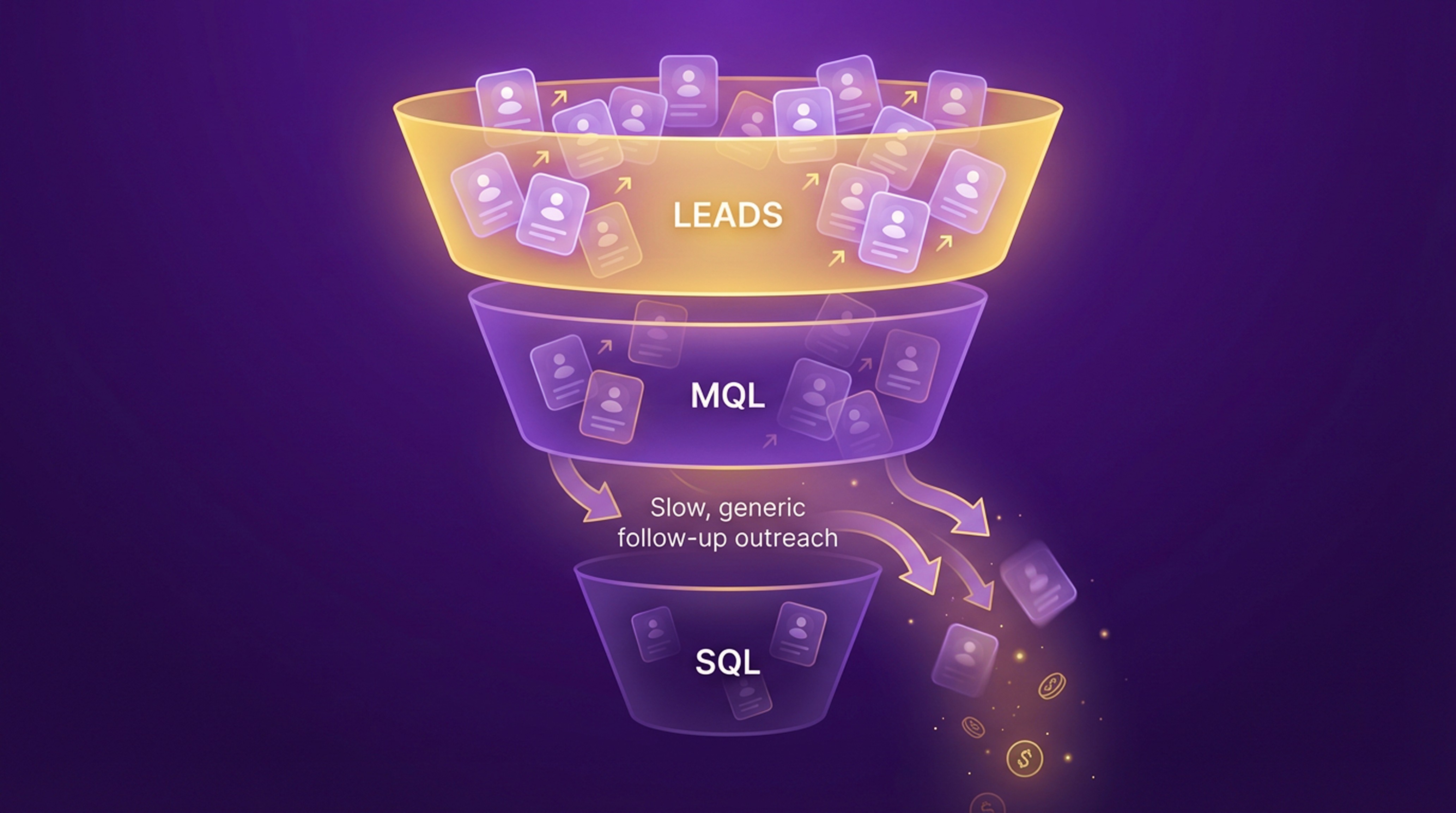
Summary
Across many B2B funnels, MQL to SQL conversion sits in the low teens, and response speed strongly impacts outcomes. Research shows that contacting a lead within five minutes versus thirty minutes can increase the odds of contact by 100 times, and increases the odds of qualification by 21 times. [2][3] For VCs, improving mid funnel conversion is a repeatable portfolio initiative: pick a cohort, standardize the inputs, run a 30 day experiment, and share the playbook across companies.
Playbook in five moves
Quantify the mid funnel leak
Fix speed and relevance
Standardize signals and content
Run a 30 day cohort experiment
Turn wins into case studies
Typical bottleneck: Low teens
First Page Sage reported MQL to SQL rates by industry, with many categories clustering around the low to mid teens.[1]
Speed to lead: 100×
Odds of contacting a lead in five minutes versus thirty minutes in the MIT lead response research. [2]
Buyer access: 17%
Gartner reported buyers spend about 17% of their time meeting with suppliers when considering a purchase. [4]
Why VCs should care about mid funnel nurturing
Mid funnel conversion is a portfolio level problem because it repeats across companies, even when products differ. Many teams invest in pipeline generation, but the handoff from marketing to sales is inconsistent, slow, or generic. That is where revenue is lost.
VCs are uniquely positioned to address it because you can standardize a lightweight operating system across multiple teams: agreed definitions for MQL and SQL, a shared response time target, and a repeatable approach to signals, content, and follow up.
Portfolio symptoms
Pipeline looks healthy, revenue misses targets
MQL volume increases, but SQL volume stays flat
Leads get one touch, then disappear
Sales says leads are low quality, marketing says sales is too slow
Why it is fixable
It is mostly a workflow and prioritization issue
Speed and relevance have measurable impact
Small gains compound downstream
Best practices transfer well across a portfolio
The portfolio math, why small lifts compound
Use this simple model with any B2B portfolio company. Start by looking at MQL to SQL. Many categories sit around the low to mid teens. [1]
A simple example
Input | Baseline | After a small lift |
|---|---|---|
Quarterly MQLs | 1,000 | 1,000 |
MQL to SQL | 13% | 18% |
SQLs created | 130 | 180 |
Incremental SQLs | 0 | +50 |
That is 50 additional sales conversations per quarter without buying additional leads. If the company has even a modest SQL to opportunity and opportunity to closed won motion, these lifts can translate into meaningful revenue.
Why this is getting harder over time
Gartner reported that buyers spend about 17% of their time meeting with suppliers when considering a purchase. [4] That means timing and relevance matter more, because you have fewer chances to earn attention.
Why leads go cold in the mid funnel
When MQLs do not become SQLs, it is rarely because the product is terrible. It is usually a combination of speed, prioritization, and generic follow up.
Slow response
Research shows the odds of contacting a lead in five minutes versus thirty minutes can drop by 100 times. [2]
Inconsistent follow up
Many teams rely on best effort. The lead gets one touch, then the next priority wins.
Generic messages
Buyers expect specificity. Generic nurture gets ignored, even when intent is real.
Harvard Business Review audited 2,241 U.S. companies and found many were far slower than they believed, with an average response time of 42 hours among firms that responded within 30 days, and a meaningful portion never responded. [5]
The takeaway for portfolio companies is simple: if you do not operationalize speed and relevance, you leak demand you already paid for.
What good looks like, Signal Activated Growth with humans in the loop
Mid funnel nurturing works when it is triggered by a reason to reach out, and when the message matches the buyer’s moment. Think of it as a simple system:
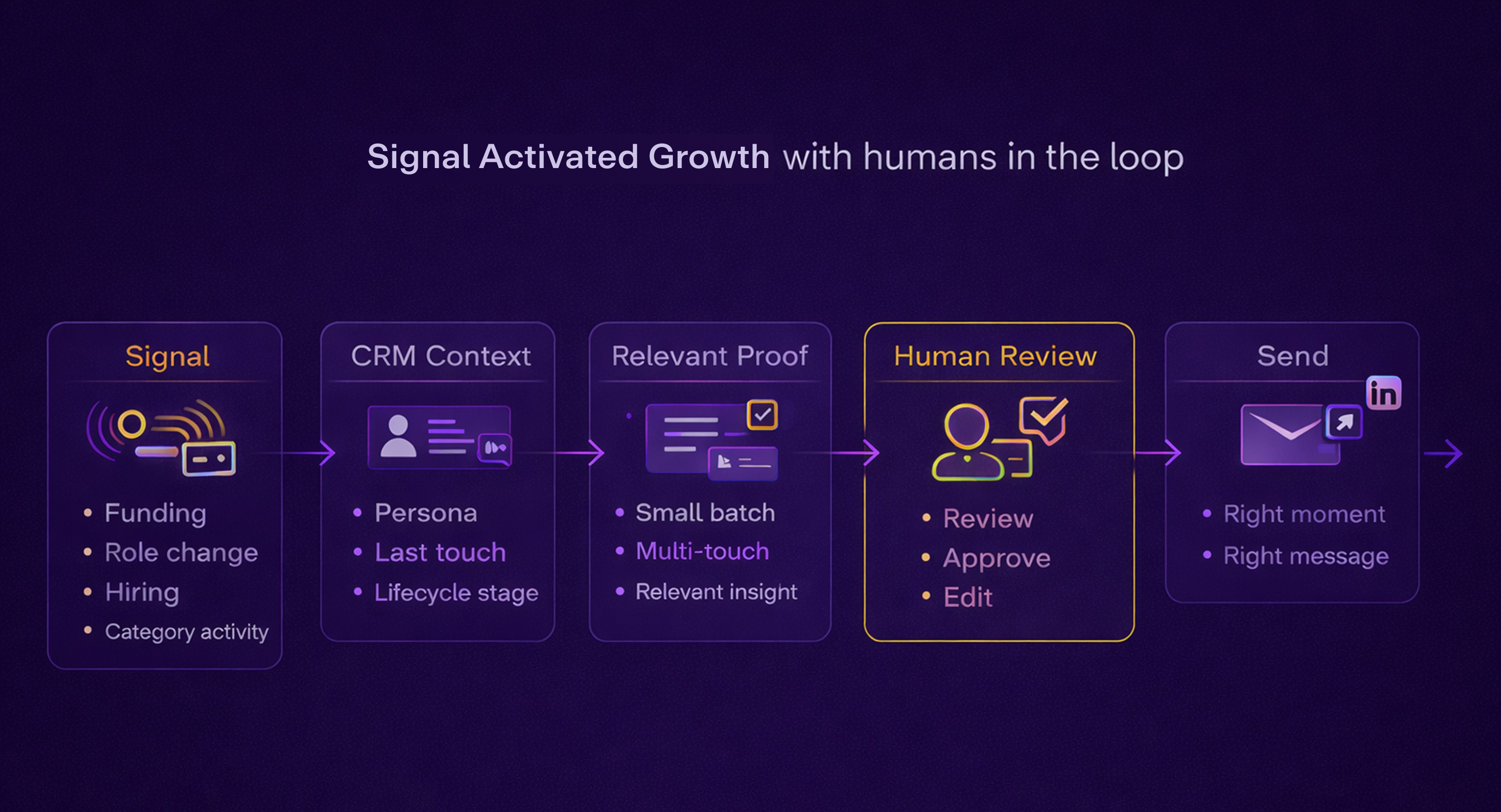
Goal: define the outcome, for example move dormant MQLs into meetings
Signal: a trigger that makes the outreach timely, job change, hiring, funding, category activity
Context: CRM relationship history, persona, last touch, lifecycle stage
Proof: one asset that matches the signal, not a generic brochure
Sequence: small batch, multi touch, with a clear owner
Human review: keep quality, tone, and accuracy high
This is the operating model behind our Lead Nurturing Agent: it watches for signals, drafts contextual follow ups, and keeps a human in the loop for review before sending.
A VC rollout plan that does not create chaos
If you want this to become a portfolio initiative, keep it simple and measurable.
Step | What to do | Output |
|---|---|---|
1. Select a cohort | Pick 3 to 5 B2B companies with pipeline but weak conversion | A focused pilot group with clear owners |
2. Standardize the inputs | Agree on ICP segment, signals, and approved proof assets | A shared playbook that is easy to reuse |
3. Run a 30 day experiment | Trigger outreach from signals, maintain human review, measure lift | A before and after dataset with learnings |
4. Share across the portfolio | Publish what worked, templates, sequences, and guardrails | A repeatable operating system for the platform team |
Metrics to track in every cohort
MQL to SQL conversion rate
Time to first follow up
Replies and meetings booked from dormant MQLs
Percent of leads receiving at least three touches
Qualitative feedback on message quality and accuracy
Beta cohort invite, portfolio companies wanted
We are opening a limited beta of our Lead Nurturing Agent for venture capital firms that want a measurable value creation initiative. The best fit is a B2B portfolio company with real pipeline, clear ICP, and a mid funnel conversion bottleneck.
What portfolio companies get
Signal based follow up recommendations
Human reviewed drafts aligned to brand voice
A 30 day experiment plan with measurement
Clear onboarding and a lightweight operating cadence
What VCs get
A repeatable portfolio playbook
Documented lifts you can share with future founders
Credibility for future raises built on operational outcomes
Case studies created in partnership with your teams
How to start
Send 2 to 3 portfolio candidates, and we will propose a cohort order, a simple success definition, and a 30 day rollout plan. If you prefer, we can start with a single company first, then expand once the workflow is proven.
FAQ
Is this only a marketing problem
No. Mid funnel conversion sits between marketing and sales. It usually fails because of shared definitions, slow follow up, and lack of a consistent system for relevance and prioritization.
What is the smallest lift that matters
Even a three to five point lift in MQL to SQL can be meaningful, because it increases the number of qualified conversations entering the pipeline.
Will this create noise for prospects
Done right, it reduces noise. Signals are used to make outreach timely and relevant, and humans review drafts before anything is sent.
What data does the system need
At minimum, CRM contact and company fields plus basic lifecycle data. Stronger results come when you add a short list of external signals and a curated proof library.
References
First Page Sage (Oct 3, 2024). “MQL to SQL Conversion Rate By Industry: 2026 Report.” firstpagesage.com/.../mql-to-sql-conversion-rate-by-industry
Oldroyd, J. (MIT). “Lead Response Management Study.” Response time analysis showing odds of contacting a lead in five minutes versus thirty minutes drop by 100 times. cdn2.hubspot.net/.../mit_study.pdf
Lead Response Management Report (MarketingSherpa archive). Qualification odds in five minutes versus thirty minutes drop 21 times. content.marketingsherpa.com/.../LeadResponseManagementReport.pdf
Gartner Press Release (Sep 15, 2020). “Gartner Says 80% of B2B Sales Interactions Between Suppliers and Buyers Will Occur in Digital Channels by 2025.” Includes the stat that buyers spend only 17% of their time meeting with potential suppliers when considering a purchase. gartner.com/.../2020-09-15-gartner-says-80--of-b2b-sales-interactions
Oldroyd, J. B., McElheran, K., Elkington, D. (Mar 2011). “The Short Life of Online Sales Leads.” Harvard Business Review. hbr.org/2011/03/the-short-life-of-online-sales-leads
Jan 12, 2026